
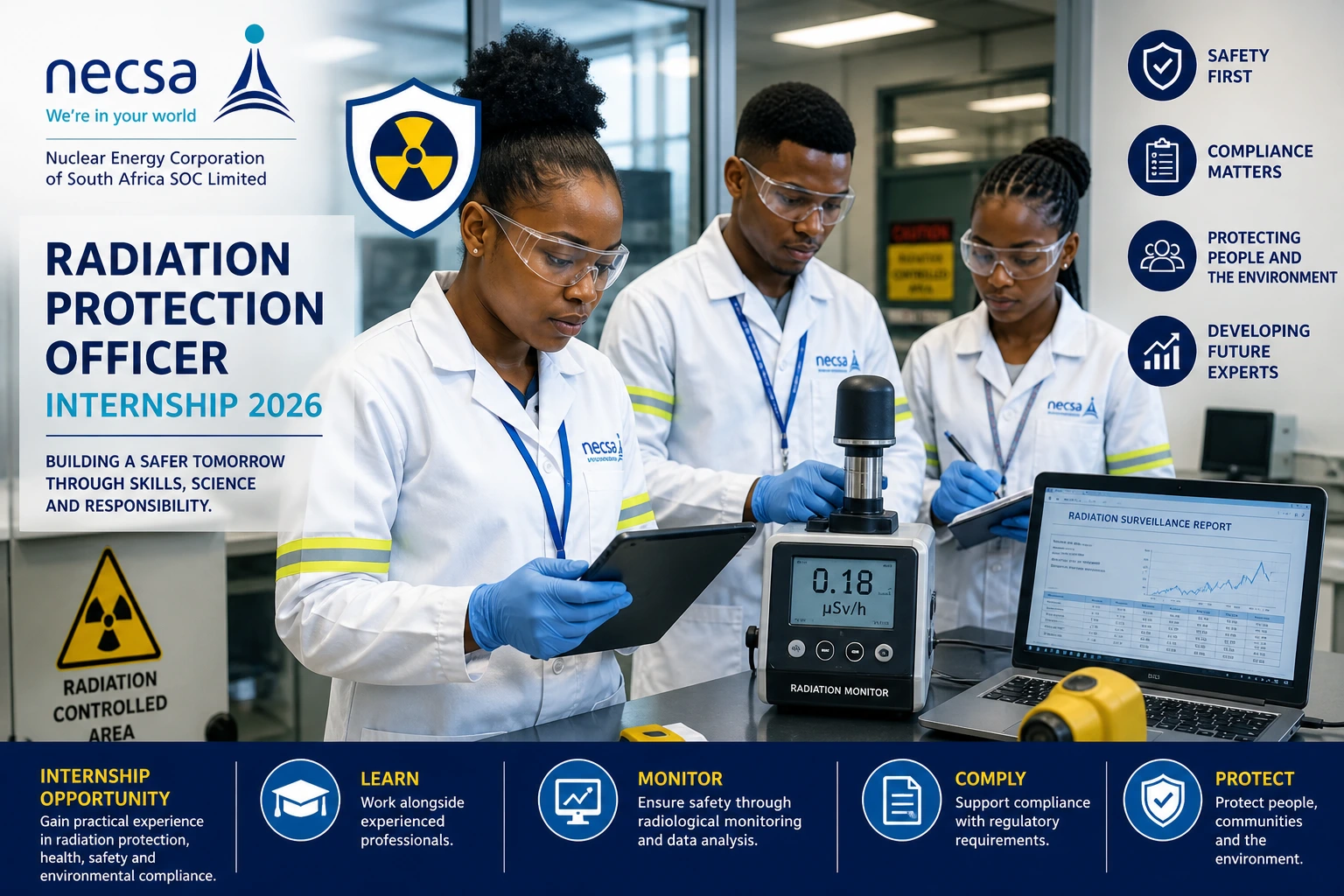
Explore the Learner Radiation Protection Officer Internship 2026 in North West—requirements, skills, and why this niche opportunity could shape a high-demand career.
The Learner Radiation Protection Officer Internship 2026 represents one of the most specialised—and often overlooked—entry points into South Africa’s scientific and nuclear safety workforce. At a time when industries are placing greater emphasis on compliance, safety, and environmental protection, roles linked to radiation protection are becoming increasingly critical.
Offered by Necsa Group, this programme provides structured, hands-on exposure within nuclear and radiological environments. Unlike general internships, this opportunity sits at the intersection of science, safety regulation, and national infrastructure—making it both technically demanding and strategically important.
ALSO APPLY FOR How to Apply for Learnerships in South Africa (Step-by-Step Guide Most Applicants Get Wrong)
Quick Facts: Learner Radiation Protection Officer Internship 2026
- Closing Date: 06 May 2026
- Location: North West, South Africa
- Duration: Not stated in the official advert
- Positions Available: 15
- Reference Number: LEARNRPO15V1
- Stipend/Salary: Market-related (exact amount not stated)
- Required Gender: Not stated in the official advert
- Company Name: Necsa Group
Why the Learner Radiation Protection Officer Internship 2026 Matters Now
Globally, industries dealing with nuclear energy, medical radiation, and industrial radiography are under increasing regulatory scrutiny. In South Africa, this is particularly relevant as the country continues to balance energy security, environmental safety, and regulatory compliance.
The Learner Radiation Protection Officer Internship 2026 is not just about training individuals—it is about maintaining national safety standards.
Radiation Protection Officers (RPOs) play a crucial role in:
- Monitoring radiation exposure
- Ensuring compliance with safety regulations
- Protecting workers and the environment
With a limited talent pool in this field, opportunities like this are both rare and valuable.
Understanding the Role: What Does a Radiation Protection Officer Do?
At its core, this internship prepares candidates to support Radiation Protection Officers in implementing safety programmes within controlled environments.
Interns will: Learner Radiation Protection Officer Internship 2026
- Monitor radiological conditions in facilities
- Assist with safety evaluations and hazard identification
- Maintain accurate records of exposure and compliance
- Support emergency preparedness and response
This is not a passive learning experience. Interns are actively involved in operational safety processes—albeit under supervision.
The role demands precision, discipline, and strict adherence to protocols. Mistakes in this field are not just administrative—they can have serious health and environmental consequences.
Skills Development: A Highly Technical and Regulated Skillset
The Learner Radiation Protection Officer Internship 2026 focuses on developing specialised competencies that are highly valued in technical industries.
Key skills include: Learner Radiation Protection Officer Internship 2026
- Data analysis and monitoring
- Report writing and documentation
- Auditing and compliance assessment
- Risk identification and hazard control
In addition, soft skills such as communication and teamwork are essential. Interns must be able to explain safety procedures clearly and work collaboratively with engineers, technicians, and facility managers.
This combination of technical and interpersonal skills makes RPOs versatile professionals in high-risk environments.
Entry Requirements: A Strong Foundation in Science
Unlike many general internships, this programme has strict academic prerequisites.
Applicants must have: Learner Radiation Protection Officer Internship 2026
- Grade 12 with Mathematics and Physical Science
- A Radiation Protection Officer Level 2 certificate
These requirements ensure that candidates already possess foundational scientific knowledge before entering the programme.
While prior experience is not mandatory, any exposure to:
- Radiological safety
- Workplace safety systems
- On-the-job technical training
will provide a significant advantage.
This reflects the technical nature of the role—basic familiarity with scientific concepts is essential for success.
Workplace Exposure: Learning Inside High-Control Environments
One of the defining features of this internship is its environment.
Participants will work in facilities where: Learner Radiation Protection Officer Internship 2026
- Radiation levels must be continuously monitored
- Access is strictly controlled
- Safety procedures are rigorously enforced
Interns will assist in:
- Conducting workplace inspections
- Evaluating safety procedures
- Supporting compliance with regulatory frameworks
They will also contribute to promoting a safety culture, which is a cornerstone of nuclear and radiological operations.
This exposure is invaluable, as it prepares candidates for careers in sectors such as:
- Nuclear energy
- Medical radiation (hospitals and radiology units)
- Mining and industrial processing
Compliance and Regulation: The Backbone of the Role
Radiation protection is heavily regulated, both nationally and internationally.
Interns will gain insight into:
- Licence conditions for nuclear facilities
- Health, Safety, Environment, and Quality (SHEQ) frameworks
- Regulatory reporting and documentation
Understanding these systems is critical. Compliance is not optional—it is legally enforced.
This experience positions interns for future roles in:
- Regulatory bodies
- Compliance departments
- Safety auditing and consulting
Recruitment Process and Employment Equity Considerations
The recruitment process includes several verification steps, reflecting the sensitive nature of the work.
These may include:
- Qualification verification
- Criminal background checks
- Credit checks (where applicable)
As an equal opportunity employer, Necsa aligns its hiring practices with the Employment Equity Act, prioritising diversity and inclusion.
For applicants, this means:
- Accuracy in applications is essential
- Integrity is a key selection factor
What This Means Going Forward
The Learner Radiation Protection Officer Internship 2026 highlights several important trends in the labour market.
1. Specialised Skills Are Increasingly Valuable
Technical fields like radiation protection offer fewer but more targeted opportunities with high long-term value.
2. Safety and Compliance Roles Are Expanding
As regulations tighten, demand for professionals who understand compliance will grow.
3. STEM-Based Careers Are Becoming More Strategic
Graduates with science backgrounds are better positioned for roles in critical industries.
4. Niche Internships Can Lead to High-Impact Careers
While less visible, programmes like this often lead to specialised, stable career paths.
For candidates, this means that pursuing niche opportunities can sometimes offer greater long-term rewards than more common career paths.
APPLY FOR Learner Radiation Protection Officer Internship 2026
FAQs-Learner Radiation Protection Officer Internship 2026
1. Do I need prior work experience to apply?
No, but any experience in radiological or safety environments will be advantageous.
2. Is this internship suitable for non-science graduates?
No. Applicants must have a strong science background, including Mathematics and Physical Science, as well as a Radiation Protection Officer Level 2 certificate.
Conclusion-Learner Radiation Protection Officer Internship 2026
The Learner Radiation Protection Officer Internship 2026 is a highly specialised opportunity that offers direct exposure to one of the most critical safety functions in modern industry.
While the entry requirements are more demanding than typical internships, the skills and experience gained are equally valuable. For candidates with a science background and interest in safety, compliance, and technical environments, this programme provides a clear pathway into a niche but impactful career.
In a job market where differentiation matters, opportunities like this stand out—not for their volume, but for their long-term potential.





Leave a Reply