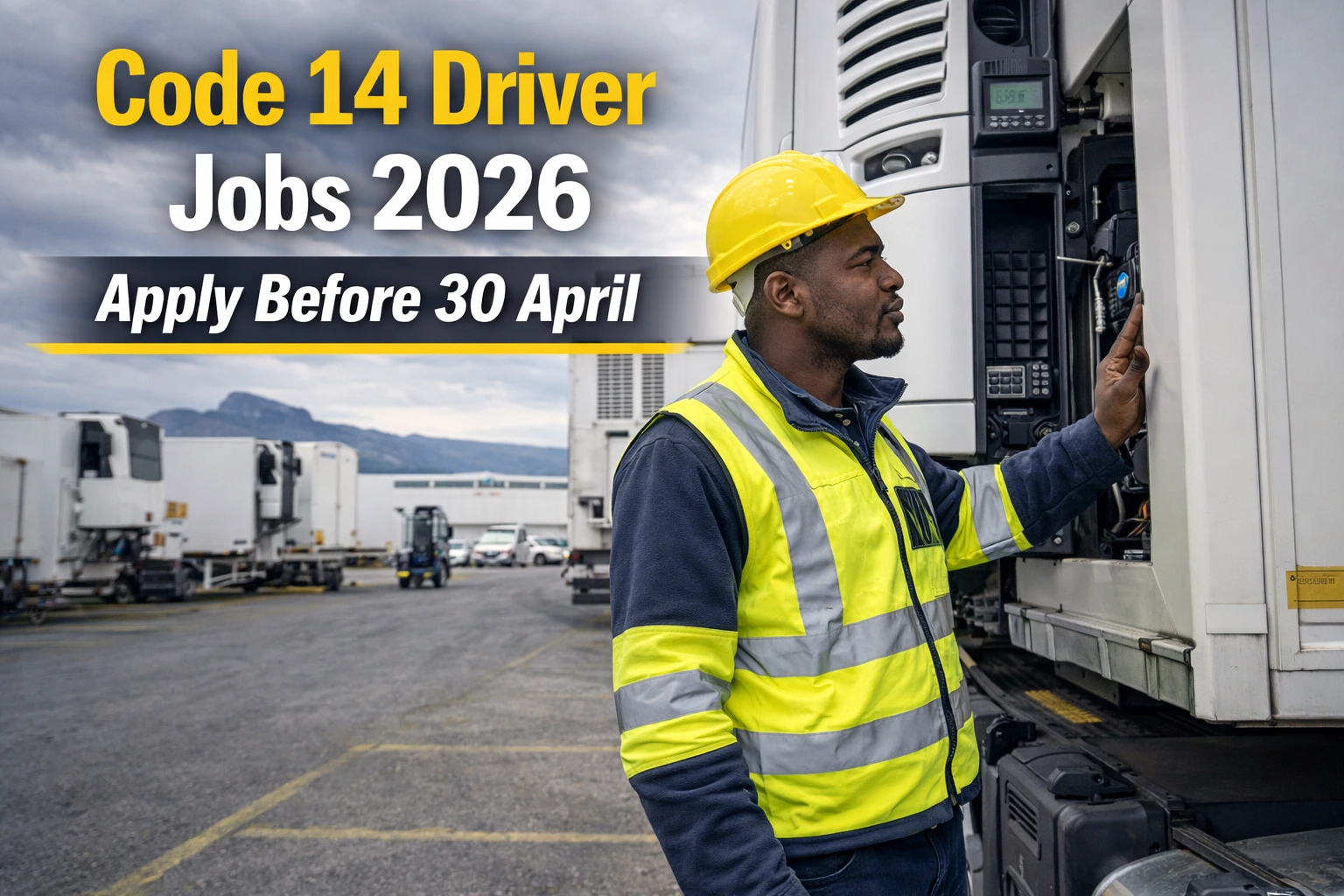

Code 14 Truck Driver job 2026 in Cape Town now open. Explore salary insights, requirements, risks, and industry trends before the 30 April deadline.
Introduction: Why This Code 14 Truck Driver Job Matters Right Now
The availability of a Code 14 Truck Driver job 2026 in Cape Town highlights a critical and often overlooked segment of South Africa’s logistics economy—cold chain transportation. As food supply chains become more complex and regulated, experienced heavy-duty drivers are no longer just operators; they are essential to maintaining product quality, safety, and delivery efficiency.
This specific opportunity from Ellahi Consulting reflects broader industry demand for drivers who can handle specialised cargo, particularly in sectors like seafood export. With global trade, strict health regulations, and rising operational standards, the expectations for drivers have evolved significantly.
For professionals in the transport sector, this is more than a job opening—it’s a reflection of how the role of a Code 14 driver is becoming increasingly technical and responsibility-driven.
ALSO APPLY FOR Gold Fields Learnerships 2026: 5 Critical Insights Every Engineering Applicant Must Know Before 17 April
Quick Facts: Code 14 Truck Driver Job 2026
- Company: Ellahi Consulting
- Location: Cape Town (Montague Gardens)
- Closing Date: 30 April 2026
- Duration: Permanent (6-month probation period)
- Positions Available: Not stated in the official advert
- Reference Number: Not stated in the official advert
- Stipend/Salary: Market related
- Required Gender: Not stated in the official advert
Understanding the Role: Beyond Driving
At first glance, the Code 14 Truck Driver job 2026 may appear to be a standard driving position. However, the job description reveals a far more complex role.
The driver is responsible for:
- Transporting seafood products
- Managing refrigeration systems
- Supervising loading and offloading
- Ensuring compliance with food safety standards
This combination of duties reflects a shift in logistics roles toward multi-functional responsibility.
In industries like seafood export, product quality is time and temperature sensitive. A minor failure—such as a temperature fluctuation—can result in:
- Product spoilage
- Financial losses
- Regulatory penalties
This means the driver plays a direct role in protecting the company’s revenue and reputation.
Cold Chain Logistics: The Hidden Complexity
One of the most critical aspects of this Code 14 Truck Driver job 2026 is its focus on cold chain logistics.
Cold chain transport involves maintaining products at specific temperatures throughout the supply chain. In this role, drivers must:
- Monitor trailer temperatures continuously
- Prevent cold-chain breaches during loading/offloading
- Maintain temperature logs for compliance
Why This Matters
South Africa’s export industry—especially seafood—depends heavily on strict international standards. Failure to meet these standards can result in rejected shipments.
From an analytical perspective, this elevates the driver’s role from operational to compliance-critical.
It also explains why experience with refrigerated trucks is listed as advantageous. This is not a preference—it is a reflection of the technical demands of the job.
Experience Requirements: Why 3–5 Years Is the Minimum
The requirement for 3–5 years of experience in heavy-duty truck driving is a strong indicator of the job’s complexity.
Applicants are expected to be familiar with:
- Fuller gearboxes
- Superlink and interlink vehicles
- Long-distance and local route planning
These are not entry-level skills.
Industry Insight
In South Africa, accidents involving heavy-duty trucks often stem from:
- Inexperience
- Fatigue
- Poor vehicle handling
By requiring mid-senior level experience, Ellahi Consulting is effectively reducing operational risk.
Additionally, familiarity with Cape Town routes is essential. Navigating urban congestion, port traffic, and industrial zones like Montague Gardens requires local knowledge and planning ability.
Compliance and Safety: A High-Stakes Environment
The Code 14 Truck Driver job 2026 places strong emphasis on compliance with:
- Road Traffic Act
- Occupational Health and Safety Act (OHSA)
- Food safety regulations
Drivers must also:
- Conduct pre-trip and post-trip inspections
- Maintain logbooks and documentation
- Ensure strict sobriety and professionalism
Analytical Perspective
This level of compliance reflects increasing regulatory pressure across the logistics sector.
Companies are now required to demonstrate:
- Traceability of goods
- Driver accountability
- Safety compliance
Failure to meet these requirements can result in legal consequences.
For drivers, this means the role is no longer just physical—it is also administrative and regulatory.
Physical and Environmental Demands: The Reality of the Job
A key but often underestimated aspect of the Code 14 Truck Driver job 2026 is its physical and environmental demands.
Drivers must be:
- Medically fit
- Able to work in sub-zero environments
- Physically capable of loading and offloading goods
What This Indicates
Working with refrigerated seafood products means exposure to:
- Cold storage environments
- Long working hours
- Physically demanding tasks
This is not a typical driving job where the driver remains in the cabin. It requires active participation in logistics operations.
From a workforce perspective, this reduces the pool of eligible candidates, increasing the value of those who meet these requirements.
Skills and Behavioural Expectations: The Modern Driver Profile
The Code 14 Truck Driver job 2026 highlights a shift toward behavioural competencies.
Key traits include:
- Integrity and accountability
- Attention to detail
- Time management
- Flexibility
Why These Matter
In a high-pressure logistics environment, delays or errors can disrupt entire supply chains.
For example:
- Late delivery → missed export deadlines
- Temperature mismanagement → product rejection
- Poor documentation → compliance issues
Employers are therefore prioritizing drivers who can operate with precision and reliability.
This reflects a broader industry trend where drivers are viewed as logistics professionals rather than just vehicle operators.
Industry Context: Growing Demand for Specialized Drivers
The demand for roles like this Code 14 Truck Driver job 2026 is increasing due to several factors:
1. Expansion of Export Markets
South Africa continues to export seafood and agricultural products globally.
2. Supply Chain Modernization
Logistics operations are becoming more sophisticated and technology-driven.
3. Regulatory Pressure
Stricter compliance requirements are raising the standard for drivers.
4. Driver Shortages
There is an ongoing shortage of experienced heavy-duty drivers.
These trends suggest that specialised drivers—especially those with cold chain experience—will remain in high demand.
What This Means Going Forward
The Code 14 Truck Driver job 2026 reflects the future direction of the logistics industry in South Africa.
- Higher skill requirements: Drivers will need both technical and compliance knowledge
- Increased responsibility: Roles will continue expanding beyond driving
- Better opportunities for experienced drivers: Skilled professionals will be in demand
- Stronger regulation: Compliance will become even more critical
For job seekers, this means investing in:
- Advanced driving skills
- Industry-specific experience
- Professional conduct and reliability
For employers, it highlights the importance of training and retaining skilled drivers.
FAQs About Code 14 Truck Driver Job 2026
1. Is a PDP required for this Code 14 Truck Driver job 2026?
A valid PDP is advantageous but not explicitly stated as mandatory in the advert.
2. Does this job involve long-distance driving?
Yes, the role includes both long-distance and local routes, depending on operational requirements.
Conclusion-Code 14 Truck Driver Job
The Code 14 Truck Driver job 2026 offered through Ellahi Consulting is a clear example of how logistics roles are evolving in South Africa.
While the position offers stability and market-related pay, it also demands a high level of responsibility, technical skill, and physical readiness.
For experienced drivers who meet the requirements, this opportunity represents a chance to work in a specialised and growing sector. However, success will depend on more than just driving ability—it will require discipline, adaptability, and a strong understanding of modern logistics operations.