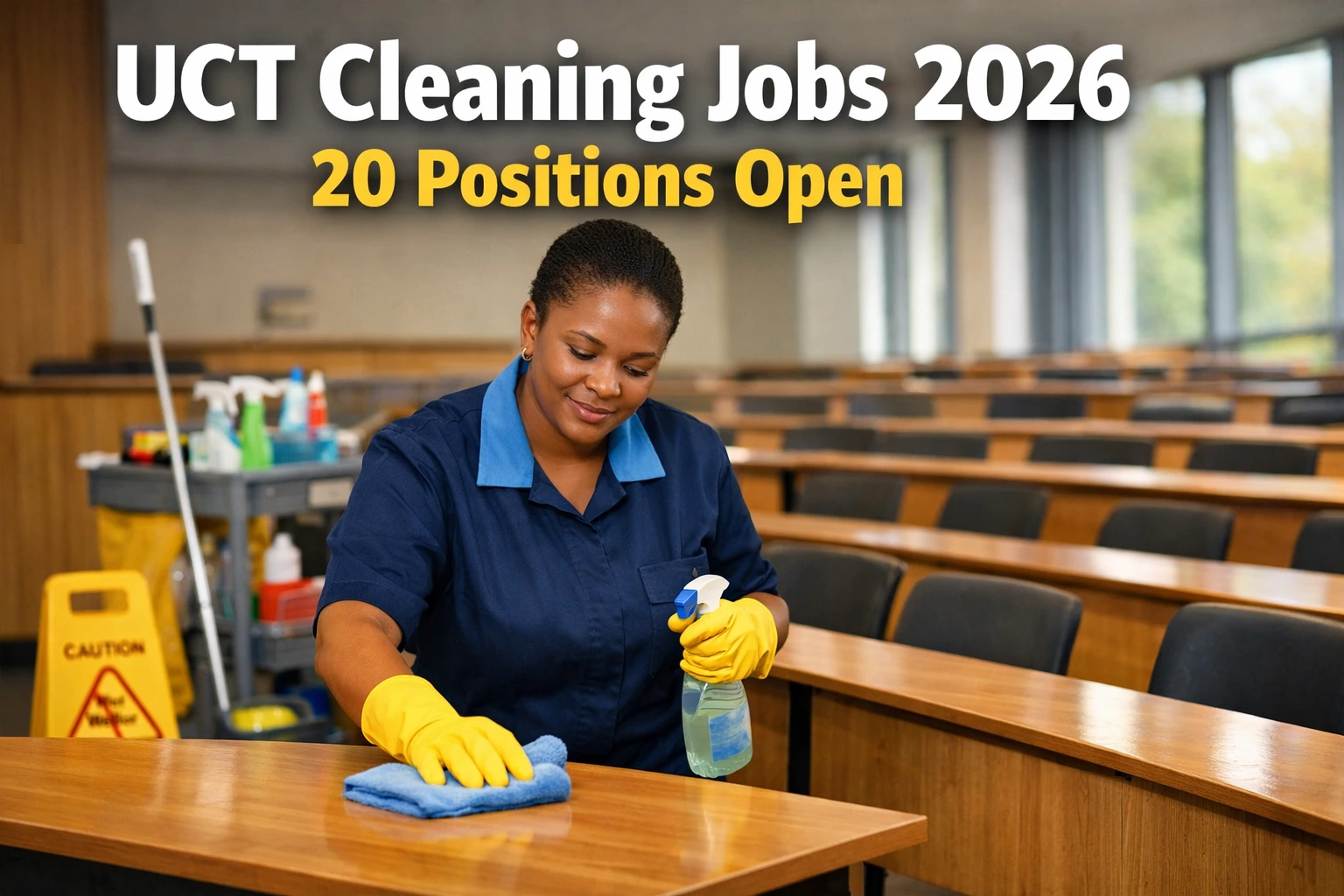

Apply for 20 permanent UCT cleaning jobs in 2026. Learn requirements, salary (R178k–R209k), duties, and why this opportunity matters now. Closing date: 24 April 2026.
Introduction: Why These UCT Cleaning Jobs Matter Right Now
The release of 20 permanent campus cleaner positions at University of Cape Town (UCT) comes at a crucial moment for South Africa’s labour market. With unemployment still disproportionately affecting low- and semi-skilled workers, opportunities that offer stable income, benefits, and institutional backing are increasingly significant.
These UCT cleaning jobs are not just entry-level roles—they represent structured employment within a respected academic institution, offering long-term stability in a sector often dominated by temporary or outsourced work. For many applicants with Grade 10 qualifications and limited experience, this opening provides a rare pathway into formal employment with growth potential.
Beyond the job itself, this recruitment drive reflects broader shifts in how universities manage facilities, prioritize hygiene standards, and create inclusive employment opportunities.
ALSO APPLY FOR Code 14 Driver Jobs in South Africa 2026
Quick Facts: UCT Cleaning Jobs 2026
- Company: University of Cape Town
- Position: Campus Cleaning Cleaner (Payclass 02)
- Positions Available: 20
- Location: Cape Town, South Africa
- Closing Date: 24 April 2026
- Reference Number: E26402
- Salary: R178,348 – R209,820 per annum
- Duration: Permanent
- Required Gender: Not stated in the official advert
Understanding the Role: More Than Just Cleaning
At first glance, campus cleaning jobs may appear straightforward, but the responsibilities outlined by UCT suggest a far more comprehensive role. The successful candidates will be responsible for maintaining an environment that supports teaching, learning, and research.
This includes:
- Daily cleaning aligned with strict institutional standards
- Deep cleaning across multiple facilities
- Waste management compliance
- Venue preparation for exams, graduations, and meetings
- Monitoring safety hazards and responding to workplace incidents
This scope highlights how modern cleaning roles have evolved. Cleaners are no longer just custodial staff—they are essential contributors to operational efficiency and public health within large institutions.
In the post-pandemic era, hygiene has become a strategic priority. Universities like UCT must maintain high sanitation standards to protect thousands of students and staff. This elevates the importance of cleaning staff and positions them as frontline contributors to institutional resilience.
Entry-Level Access with Structured Expectations
One of the most notable aspects of these UCT cleaning jobs is the relatively accessible entry requirement:
- Grade 10
- One year of relevant experience
This makes the opportunity particularly appealing to job seekers who may not have completed matric but possess practical work experience. However, accessibility does not mean simplicity.
UCT emphasizes:
- Strong communication skills
- Teamwork
- Knowledge of cleaning equipment and chemicals
- Efficiency in resource usage
This reflects a broader labour trend: even entry-level roles now demand soft skills and technical awareness. Employers increasingly expect workers to contribute to productivity, cost control, and workplace safety—not just complete tasks.
For applicants, this means that demonstrating reliability, attention to detail, and basic technical knowledge can significantly improve employability.
The Economics of the Salary Package
The annual salary range of R178,348 to R209,820 positions these roles above many informal or contract-based cleaning jobs in South Africa.
To put this into perspective:
- Many outsourced cleaning roles offer lower wages with limited benefits
- Permanent employment typically includes additional benefits such as leave, medical support, and pension contributions
This makes UCT cleaning jobs financially competitive within the sector.
Moreover, the emphasis on “cost of employment including benefits” suggests a total compensation package rather than just basic salary. This is important because benefits often account for a significant portion of long-term financial security.
For job seekers, this represents more than a paycheck—it’s a step toward economic stability.
Institutional Employment vs Outsourcing Trends
A key insight from this advert is that UCT is hiring cleaners directly rather than outsourcing the function. This is significant in the South African context.
Many institutions have historically outsourced cleaning services to reduce costs. However, this often results in:
- Lower wages
- Reduced job security
- Limited career progression
By offering permanent positions, UCT signals a shift toward internal workforce development. This aligns with growing pressure on institutions to improve working conditions and reduce inequality within their employment structures.
For workers, direct employment by a university offers:
- Greater job security
- Better working conditions
- Access to institutional resources and support
This trend may influence other universities and public institutions to reconsider their employment models.
Operational Complexity Behind Campus Cleaning
Managing cleaning services at a university is far more complex than in smaller environments. UCT’s campus includes:
- Lecture halls
- Laboratories
- Residences
- Administrative offices
- Event venues
Each of these spaces has different cleaning requirements, safety protocols, and usage patterns.
For example:
- Laboratories require strict chemical handling procedures
- Examination venues must be prepared to precise standards
- Graduation ceremonies demand rapid, large-scale setup and cleanup
This complexity explains why UCT places emphasis on teamwork, communication, and procedural compliance. Cleaning staff must coordinate with supervisors and other departments to ensure smooth operations.
It also highlights the potential for skill development within the role. Workers gain experience in logistics, safety management, and facility operations—skills that can be transferred to other sectors.
Application Process: A Structured and Competitive System

Applying for these UCT cleaning jobs requires careful attention to detail. Candidates must submit:
- UCT application form (downloadable via UCT HR Forms)
- Cover letter
- Curriculum Vitae (CV)
All documents must be combined into a single PDF and emailed to recruitmentcpt@sdrecruit.co.za with the correct reference number.
This structured process serves two purposes:
- Filtering serious applicants – Ensures candidates can follow instructions
- Standardizing evaluation – Allows fair comparison across applicants
Failure to comply results in automatic disqualification. This highlights the importance of administrative accuracy, even for entry-level roles.
Additionally, shortlisted candidates may undergo assessments and must pass a medical evaluation due to the physical demands of the job.
Employment Equity and Inclusion Considerations
UCT explicitly states its commitment to employment equity and diversity. Preference will be given to candidates from under-represented designated groups.
This aligns with South Africa’s broader transformation goals and legislative framework.
From an analytical perspective, this means:
- The recruitment process is not purely merit-based but also equity-driven
- Candidates from historically disadvantaged backgrounds may have an advantage
For applicants, understanding this context is important when assessing their chances and preparing their applications.
What This Means Going Forward
The release of these UCT cleaning jobs reflects several important trends in South Africa’s labour market and institutional practices:
1. Growing Value of Essential Work
Cleaning roles are increasingly recognized as critical to health, safety, and operational continuity. This elevates their importance and justifies better compensation and conditions.
2. Shift Toward Direct Employment
Institutions may gradually move away from outsourcing toward permanent staffing models, improving job security and worker welfare.
3. Rising Expectations for Entry-Level Workers
Even roles requiring minimal formal education now demand a mix of technical knowledge and soft skills. This raises the bar for employability.
4. Continued Focus on Equity
Employment equity policies will continue to shape hiring outcomes, particularly in public institutions.
5. Increased Competition for Stable Jobs
With high unemployment, opportunities like these will attract large applicant pools, making preparation and compliance critical.
For job seekers, the key takeaway is clear: opportunities exist, but securing them requires attention to detail, basic skills development, and an understanding of employer expectations.
How to Apply:
Email the following in one PDF file to:
recruitmentcpt@sdrecruit.co.za
Documents required:
- UCT Application Form (download: http://forms.uct.ac.za/hr201.doc)
- Cover Letter
- CV
Important:
- Include title & reference number in subject line
- Incomplete applications will not be considered
- Only shortlisted candidates will be contacted
- Medical evaluation required before employment
Contact:
Telephone: 021 948 3451
Website: www.hr.uct.ac.za
Reference Number: E26402
Closing Date: 24 April 2026
FAQs
1. Do I need matric to apply for these UCT cleaning jobs?
No. The minimum requirement is Grade 10, along with at least one year of relevant cleaning experience.
2. Are these UCT cleaning jobs permanent or contract-based?
These are permanent positions, offering long-term employment and benefits.
Conclusion
The UCT cleaning jobs for 2026 offer more than just employment—they represent stability, institutional support, and a pathway into structured work for individuals with limited formal qualifications.
In a challenging economic environment, opportunities like this stand out for their combination of accessibility and security. However, the structured application process and competitive nature of the roles mean that applicants must approach the opportunity with seriousness and preparation.
For those who meet the requirements and submit a complete application, this could be a meaningful step toward long-term career stability within one of South Africa’s leading universities.