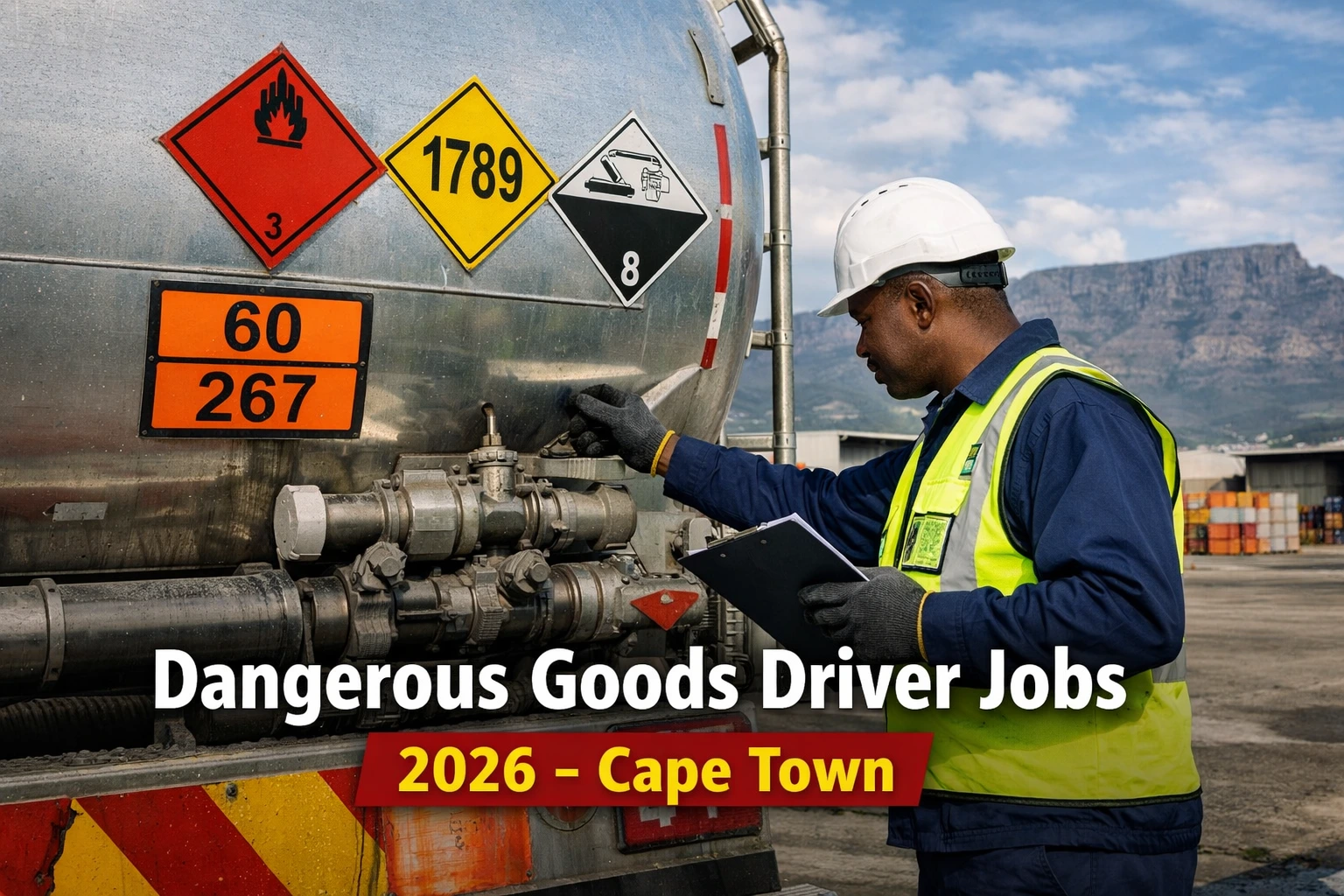

Explore the growing demand for Code 14 Dangerous Goods Driver jobs in Cape Town, key requirements, industry risks, and what this role means for South Africa’s logistics sector in 2026.
Code 14 Dangerous Goods Driver Cape Town: A Critical Role in South Africa’s Logistics Chain
The demand for a Code 14 Dangerous Goods Driver Cape Town is rising sharply in 2026, reflecting deeper shifts in South Africa’s manufacturing and logistics sectors. As industrial zones expand and supply chains become more complex, the safe transportation of hazardous materials has moved from a niche function to a critical operational priority.
This specific opportunity in Cape Town, particularly in the industrial hub of Epping Industrial Area, highlights how companies are investing in highly skilled drivers capable of handling dangerous goods responsibly. But beyond the job listing itself lies a broader story about regulation, risk management, and economic activity.
Understanding this role requires looking not just at the responsibilities, but at the evolving ecosystem that makes such positions indispensable.
ALSO APPLY FOR X5 Drivers at Motus Corporation
Quick Facts Box
- Closing Date: Not stated in the official advert
- Location: Cape Town (Epping)
- Duration: Contract
- Positions Available: Not stated in the official advert
- Reference Number: Not stated in the official advert
- Stipend: Not stated in the official advert
The Rising Importance of Dangerous Goods Transport
The transportation of hazardous materials—ranging from chemicals to flammable liquids—is tightly regulated for good reason. A single mistake can result in environmental damage, financial loss, or even loss of life.
In industrial zones like Epping Industrial Area, manufacturing activity continues to grow, driving demand for reliable logistics professionals. This has elevated the Code 14 Dangerous Goods Driver Cape Town role into a high-responsibility occupation that requires both technical skill and strong decision-making ability.
Unlike general freight drivers, dangerous goods drivers operate under stricter compliance frameworks. This includes adherence to safety protocols, documentation accuracy, and route planning that minimizes risk exposure. As supply chains expand, these drivers become the backbone of safe industrial operations.
What Sets Code 14 Dangerous Goods Drivers Apart
Holding a Code 14 license alone is no longer enough. Employers are increasingly looking for drivers with a Dangerous Goods endorsement, reflecting a shift toward specialization in the logistics sector.
A Code 14 Dangerous Goods Driver Cape Town must demonstrate:
- Advanced knowledge of hazardous material classifications
- Understanding of emergency response procedures
- Ability to conduct detailed vehicle inspections
- Strong compliance with regulatory frameworks
This specialization aligns with global trends where logistics roles are becoming more technical. In South Africa, this shift is particularly important given the country’s reliance on road transport over rail for industrial goods.
Drivers are no longer just operators—they are safety managers on wheels.
Operational Challenges in High-Risk Transport
Transporting dangerous goods introduces a layer of complexity that goes far beyond standard logistics. Drivers must constantly balance efficiency with safety.
For example, route planning is not simply about distance or fuel consumption. It must consider:
- Population density
- Road conditions
- Emergency response accessibility
- Environmental sensitivity
In areas like Cape Town, where urban development intersects with industrial zones, these decisions become even more critical.
Additionally, unpredictable factors such as traffic congestion or mechanical issues can escalate quickly when hazardous materials are involved. This is why employers prioritize candidates who can make quick, informed decisions under pressure.
Compliance, Regulation, and Industry Standards
The regulatory environment surrounding dangerous goods transport is stringent—and becoming stricter.
A Code 14 Dangerous Goods Driver Cape Town must comply with:
- National road traffic regulations
- Hazardous materials handling laws
- Company-specific safety protocols
Failure to comply can result in severe penalties, including fines, license suspension, or criminal liability.
This regulatory pressure has led companies to invest more heavily in experienced drivers with clean records. The requirement of no major traffic violations in the past five years is not just a preference—it is a risk mitigation strategy.
In this context, drivers serve as the final checkpoint in a chain of compliance that begins at manufacturing and ends at delivery.
The Human Factor: Skills Beyond Driving
While technical qualifications are essential, the human element plays a significant role in this profession.
The job advert emphasizes communication, teamwork, and adaptability—skills that are often overlooked in traditional driving roles. A Code 14 Dangerous Goods Driver Cape Town must interact with dispatchers, clients, and safety personnel, often under time-sensitive conditions.
Physical endurance is another critical factor. Long hours on the road, combined with the mental strain of handling hazardous materials, require a high level of resilience.
This combination of technical expertise and soft skills reflects a broader shift in the labor market, where hybrid skill sets are becoming the norm.
Why Epping Remains a Strategic Logistics Hub
The location of this role in Epping Industrial Area is not coincidental.
Epping is one of the oldest and most established industrial zones in the Western Cape. Its proximity to major transport routes and the port of Port of Cape Town makes it a key node in regional and international trade.
For a Code 14 Dangerous Goods Driver Cape Town, working in Epping means being at the center of high-volume logistics operations. This increases both the opportunities and the responsibilities associated with the role.
As infrastructure investments continue, Epping’s importance is likely to grow, further driving demand for specialized drivers.
What This Means Going Forward
The increasing demand for a Code 14 Dangerous Goods Driver Cape Town signals a broader transformation in South Africa’s logistics and manufacturing sectors.
Several trends are likely to shape the future:
- Increased specialization: More drivers will need certifications beyond standard licensing.
- Stricter compliance: Regulatory frameworks will continue to tighten.
- Technology integration: GPS tracking, telematics, and safety monitoring systems will become standard.
- Higher expectations: Employers will prioritize experience, reliability, and adaptability.
For job seekers, this means that entering the field requires more preparation—but also offers greater long-term stability and earning potential.
For employers, the challenge will be attracting and retaining skilled drivers in a competitive market.
FAQs
1. What is a Code 14 Dangerous Goods Driver?
A driver licensed to operate heavy vehicles and certified to transport hazardous materials safely.
2. Is a Dangerous Goods endorsement mandatory?
Yes, for transporting hazardous materials legally and safely.
3. Where is this job located?
In Cape Town, specifically in the Epping industrial area.
4. What experience is required?
Proven experience in transporting dangerous goods and a clean driving record.
5. Is this a permanent job?
No, the advert specifies a contract position.
Conclusion
The Code 14 Dangerous Goods Driver Cape Town role is more than just another logistics job—it is a critical function within a high-stakes industry. As South Africa’s manufacturing and transport sectors continue to evolve, the importance of skilled, compliant, and adaptable drivers will only increase.
For those who meet the qualifications, this role offers both challenge and opportunity. But it also demands a level of professionalism and responsibility that goes far beyond the average driving job.